Thermal Vacuum Testing
Have Questions?
Submit the contact form below and one of our electrical testing experts will connect with you right away.
Thermal Vacuum (TVAC) Testing
Space-environment thermal and vacuum testing for mission-critical EEE components aligned to MIL-STD and NASA requirements
Principles and Applications in Space-Qualified Electronics
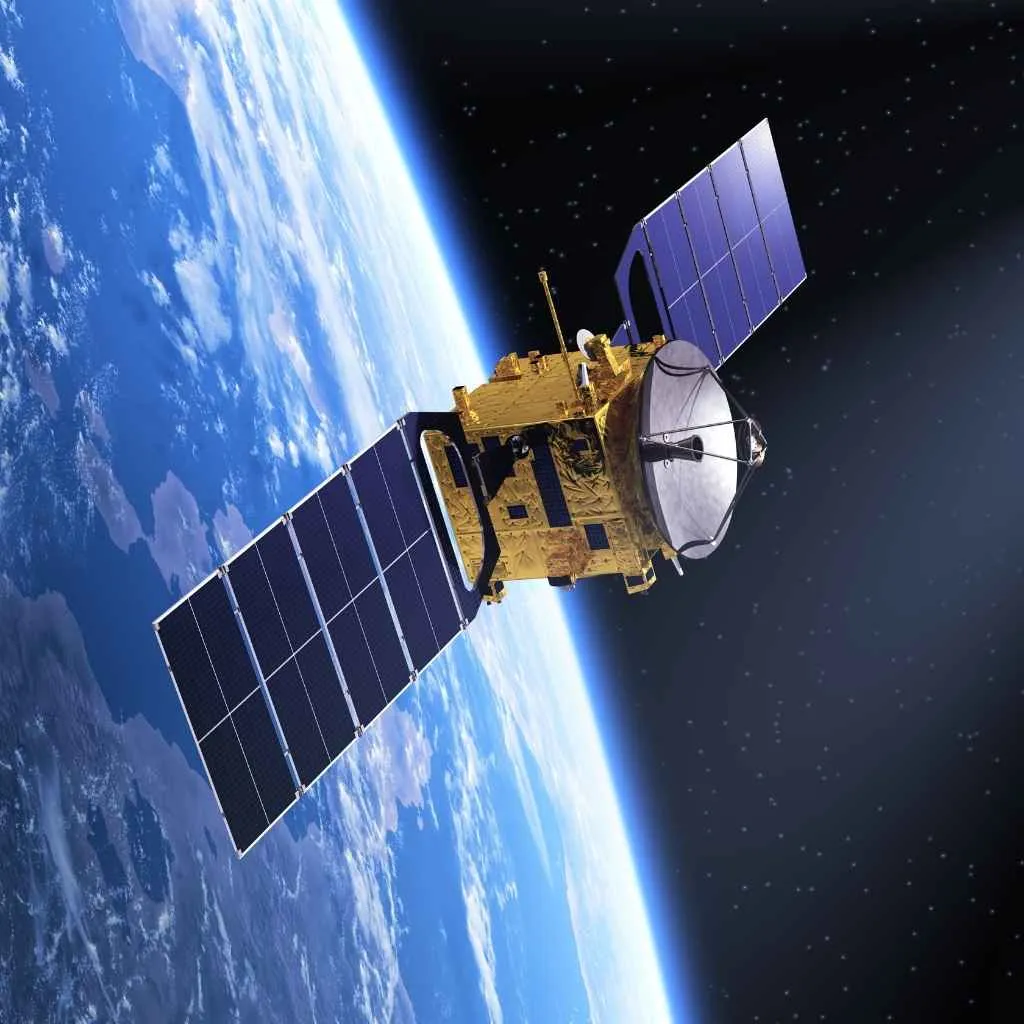
Thermal vacuum (TVAC) testing replicates the combined vacuum and thermal extremes of space environments to qualify electrical, electronic, and electromechanical (EEE) components for mission-critical performance. This process subjects hardware to low pressures (down to 10⁻⁶ Torr) and temperature cycles (-60°C to +105°C) that mimic orbital eclipses, solar exposure, and deep-space soaks, revealing outgassing, thermal expansion mismatches, and material degradation while validating predictive models.
Grounded in standards like ECSS-Q-ST-70-02C and NASA-STD-7002, TVAC provides empirical data on thermal balance, functional stability, and contamination risks, supporting qualification, acceptance, and flightworthiness certification for satellites, payloads, and rovers.
At AAA Engineering & Test Lab, TVAC is integrated into broader Hi-Rel and space qualification programs or deployed as a standalone service for component and assembly-level evaluations.
Vacuum and Thermal Regimes: Fundamental Principles
TVAC integrates vacuum evacuation with controlled thermal gradients, each targeting distinct environmental stressors:
- Vacuum: Achieves space-like pressures via roughing (760–1 Torr), high-vacuum (10⁻³–10⁻⁷ Torr), and ultra-high-vacuum (≤10⁻⁷ Torr) stages using rotary vane, turbomolecular, and cryopump sequences. This exposes outgassing volatiles (e.g., water vapor from polymers) and assesses hermeticity, per MIL-STD-883 Method 1014, preventing condensation on optics or shorts in insulators.
- Thermal Cycling: Applies radiant heat via shrouds or liquid nitrogen-cooled panels, simulating 500°C surface deltas on airless bodies like the Moon. Cycles (e.g., 10–50 per test) induce stresses from coefficient-of-thermal-expansion (CTE) mismatches, with dwell times revealing latent defects like microcracks in solder joints.
Instrumentation tracks chamber pressure, shroud temperatures, and component telemetry (e.g., thermocouples, RTDs) to quantify heat transfer via radiation (Q = εσA(T⁴₁ – T⁴₂)) and conduction, ensuring negligible convection.
Applications in Space and High-Reliability Systems
Space hardware endures vacuum-induced molecular boiling and thermal swings from -150°C shadowed craters to +120°C sunlit peaks, risking delamination in multi-chip modules or bias shifts in semiconductors. High-reliability terrestrial analogs, like vacuum furnace controls, face similar isolation challenges.
TVAC addresses:
- Orbital Dynamics: Eclipse transitions (e.g., ±100°C/min) and solar array gradients, verifying power electronics stability.
- Planetary Surfaces: Lunar/Martian day-night cycles (14 Earth days), including regolith abrasion simulations for rover sensors.
- Deep-Space Probes: Prolonged cryogenic soaks (-200°C) to evaluate battery discharge rates and adhesive integrity.
Results inform contamination control plans and thermal design, minimizing anomalies like those in early Hubble deployments.
Key Standards and Methods
Established protocols ensure traceability and severity alignment:
| Standard | Scope | Principal Methods | High-Rel Applications |
|---|---|---|---|
| ECSS-Q-ST-70-02C | Space product assurance | Bake-out at 10⁻⁶ Torr/125°C; 20 cycles -50°C to +80°C | ESA satellite qualification; MLI validation. |
| NASA-STD-7002 | Payload safety requirements | Functional TVAC with 10⁻⁵ Torr; thermal balance tests | Artemis landers; COTS up-screening. |
| MIL-STD-883 Method 1014 | Microcircuit vacuum stability | Steady-state 10⁻⁵ Torr/125°C for 96 hrs | Hermetic packages in avionics. |
| MIL-STD-202 Method 106 | Component thermal shock/vacuum | 10 cycles -65°C to +150°C in 5×10⁻³ Torr | Connectors and passives for payloads. |
| ISO 14644-1 | Cleanroom/contamination control | Outgassing quantification (TVCM) | Optical systems; particle monitoring. |
| ASTM E595 | Outgassing materials | 125°C/7×10⁻³ Torr; TML/CVCM limits <1%/0.1% | Composites in structural electronics. |
These frameworks harmonize DoD and commercial needs, with options for combined radiation exposure. TVAC test conditions are selected to align with program-level standards and can be combined with other Hi-Rel services such as vibration, life testing, and DPA to support full qualification plans.
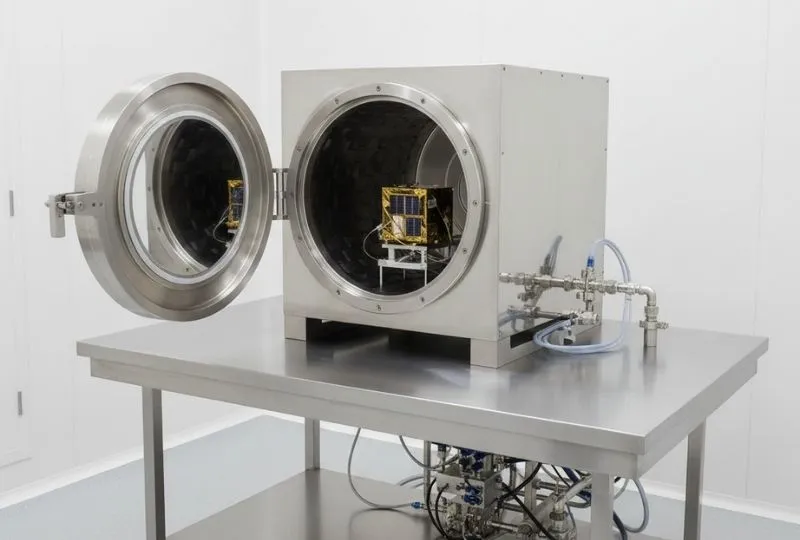
Thermal Vacuum Testing Process Overview
TVAC follows a phased, data-driven workflow:
- Preparation: Define profiles from thermal desktop models (e.g., SINDA/FLUINT); perform bake-out (50–150°C in vacuum) to desorb contaminants. Mount unit-under-test (UUT) on conductive fixtures with multipoint thermocouples and quartz crystal microbalances for mass loss tracking.
- Chamber Evacuation: Sequence pumps to target pressure; monitor partial pressures (H₂O, N₂) via residual gas analyzers to confirm <10⁻⁶ Torr.
- Thermal Profiling: Ramp shrouds per mission envelope (e.g., hot-case +100°C soak, cold-case -160°C); apply 15–30 cycles with functional stimuli like voltage bias or signal pulsing.
- Monitoring and Control: Real-time acquisition of temperatures, pressures, and electrical parameters (e.g., leakage current <1 nA); adjust for equilibrium (±2°C stability).
- Post-Test Analysis: Inspect for particulates via SEM/EDS; correlate data to FEA models; generate reports with pass/fail criteria under ISO/IEC 17025.
Benefits for Design and Qualification
- Defect Localization: Detects subtle issues like interfacial voids, enabling targeted mitigations like underfill epoxies.
- Model Refinement: Empirical gradients validate CFD predictions, improving margins by 20–30% for subsequent designs.
- Efficiency Gains: Consolidates quals, cutting program costs by avoiding flight anomalies, as evidenced in post-Apollo hardware evolutions.
These advantages fortify supply chains for resilient, space-grade electronics. For many programs, thermal vacuum testing is one of the earliest and most critical steps in qualifying new materials, components, or assemblies for space environments.
TVAC in AAA’s Hi-Rel & Space Qualification Program
TVAC is one of four core environmental and analytical tests within AAA’s space qualification platform, alongside Radiation Hardness Assurance (RadHard), Shock & Vibration, and DPA. These services can be integrated into turnkey, standards-aligned flows for flight acceptance or mission assurance.
Related Services:
Advance Your Qualification Efforts
At AAA Engineering & Test Lab, our team offers comprehensive TVAC solutions tailored for passives, ICs, and assemblies. Drawing on our engineering expertise in MIL-STD-883 and NASA standards, we deliver precise environmental simulations and failure analysis to up-screen COTS components for demanding aerospace applications. Contact Us to discuss how we can support your thermal vacuum needs with actionable insights and seamless project management.
Why Customers Choose AAA Engineering
- American Owned: We are 100% American owned, and operated by veterans of the US Air Force, US Army, US Marines, and US Navy.
- Proven Expertise: 15+ years of upscreening and component data.
- Technical Authority: Skilled in MIL-STD, NASA, and AS6171 standards.
- Certified Excellence: DLA-Approved Test Laboratory, ISO/IEC 17025, AS6081, AS6171, ISO 9001/AS9100, ANSI/ESD S20.20, ITAR-registered.
- Trusted Results: Transparent, traceable data logs for reliability.
- Scalable Solutions: Supports prototype to production volumes.
Ready to Validate Your Components or Assemblies with TVAC?
Certifications